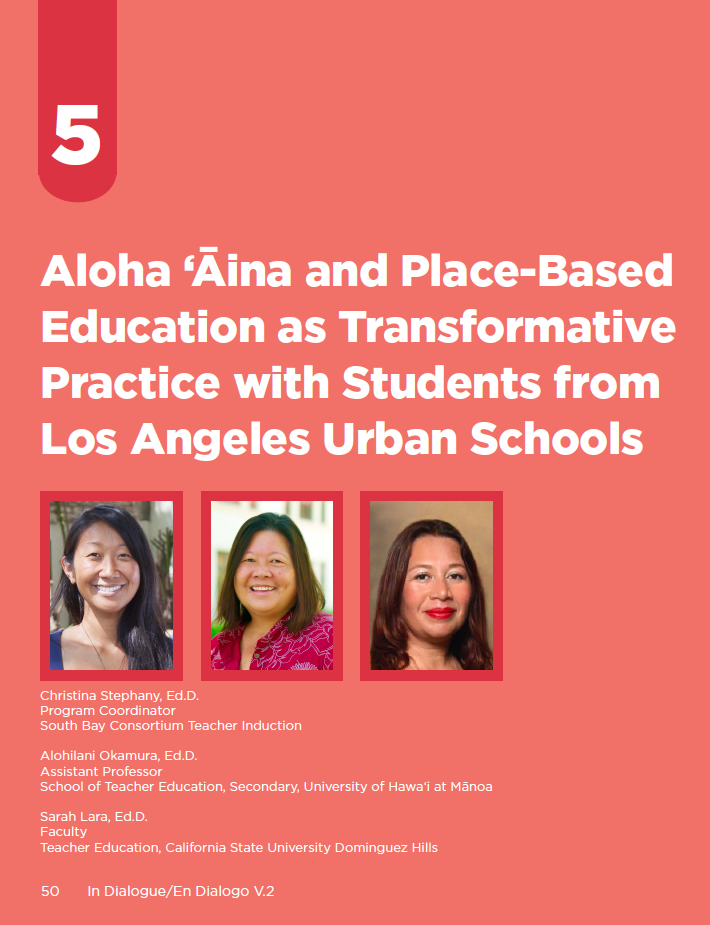
Aloha ʻĀina and Place-based Education as Transformative Practice with Students from Los Angeles Urban Schools
Article Sidebar
Main Article Content
Abstract
Place-based education (PBE) has been envisioned across liberal, critical, and Indigenous perspectives. Within this piece, we unravel our reflections, planning and teaching a pre-college seminar grounded in critical and Indigenous perspectives of PBE for secondary students from Los Angeles urban schools. Grounding the course within the Hawaiian principles of pilina, kuleana, and aloha (relationships, responsibility, and care), we gave time and space for students to develop their identities by studying the complex interactions of a community rooted in a place of their choice. Drawing upon the methods of duoethnography, we share how centering identity development through the study of place shifted dominant power structures within K-12 education and how the focus on relationships across generations makes the process the product of students’ learning. As teachers and teacher educators, our reflections share our transformation and the potential transformation for students to develop aloha ʻāina, a reciprocal relationship with place.